
Entities Illustration
This page walks through an example that ties the concepts of Fuzzball organizations, users, and groups together. Consider the example below:
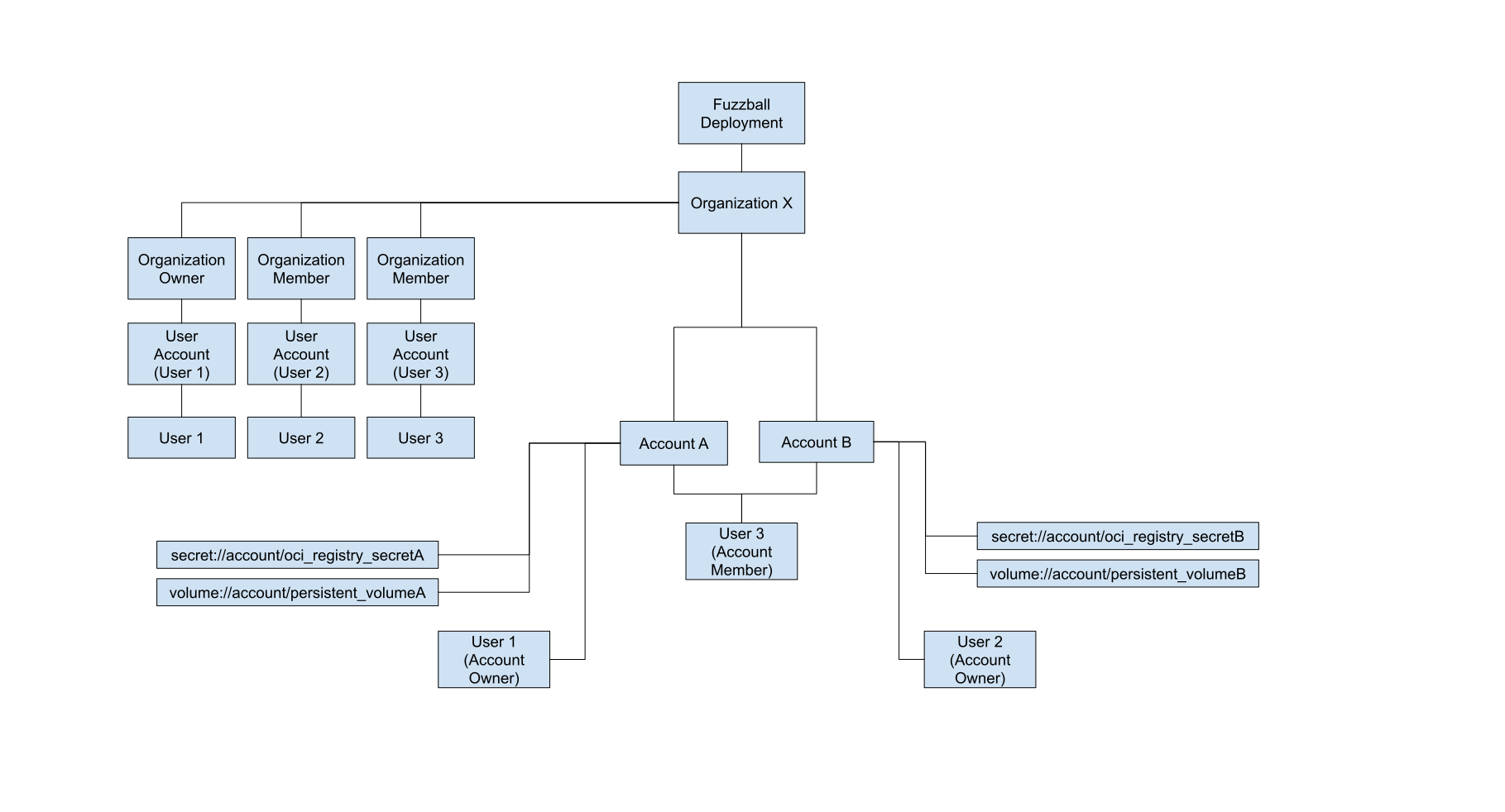
The diagram shows a Fuzzball deployment that consists of Organization X.
Organization X contains users User 1, User 2, and User 3. User 1 is the organization owner. As organization owner, User 1 controls the organization itself, its members, the groups within it, and the owners and members of those groups. User 2 and User 3 are organization members. By default, each user is a member and owner of their own user group.
User 1, being the organization owner, has created groups Group A and Group B. They have
added themselves as the group owner of Group A and User 2 as the group owner of
Group B. Within Group A, User 1, being the group owner, has created storage
volume volume://group/persistent/volumeA and
secret secret://group/oci_registry_secretA. Within Group B, User 2, being the group
owner of Group B, has created storage volume volume://group/persistent/volumeB and secret
secret://group/oci_registry_secretB.
User 3 has been added as a group member of Group A and Group B. When User 3
is using Group A, they can use storage volume
volume://group/persistent/volumeA, secret secret://group/oci_registry_secretA, and see
workflows submitted by User 1. When User 3
is using Group B, they can use storage volume
volume://group/persistent/volumeB, secret secret://group/oci_registry_secretB, and see
workflows submitted by User 2.
Since User 1 is not a member of Group B, they cannot access storage volume
volume://group/persistent/volumeB, secret secret://group/oci_registry_secretB, or any
workflow/Fuzzfile executed within Group B. Since
User 2 is not a member of Group A, they cannot access storage volume
volume://group/persistent/volumeA, secret secret://group/oci_registry_secretA, or any
workflow/Fuzzfile executed within Group A.